For structural engineers, 2–15 years in
Be the engineer who
already knows the answer.
Not the one who runs the model. The one who can tell you roughly what it should say before it opens — and knows when it's lying.
Analysis is cheap now. The judgement to know what looks right and what looks wrong is not — and it has only ever come from reps you had to be lucky to receive. The right project, the right supervisor, the right decade. This is one drill, repeated: estimate the answer, commit to it, and find out immediately how close you were.
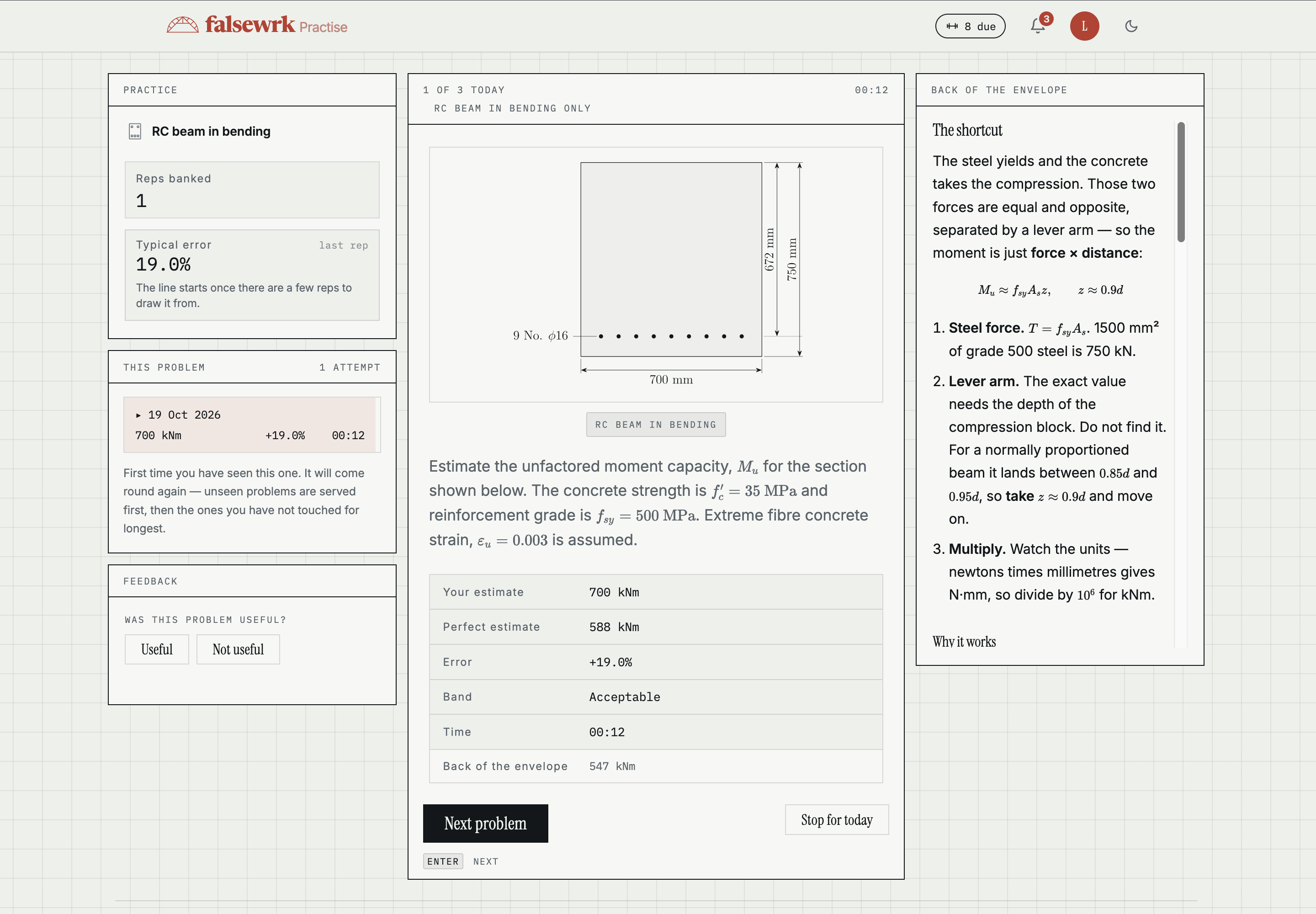
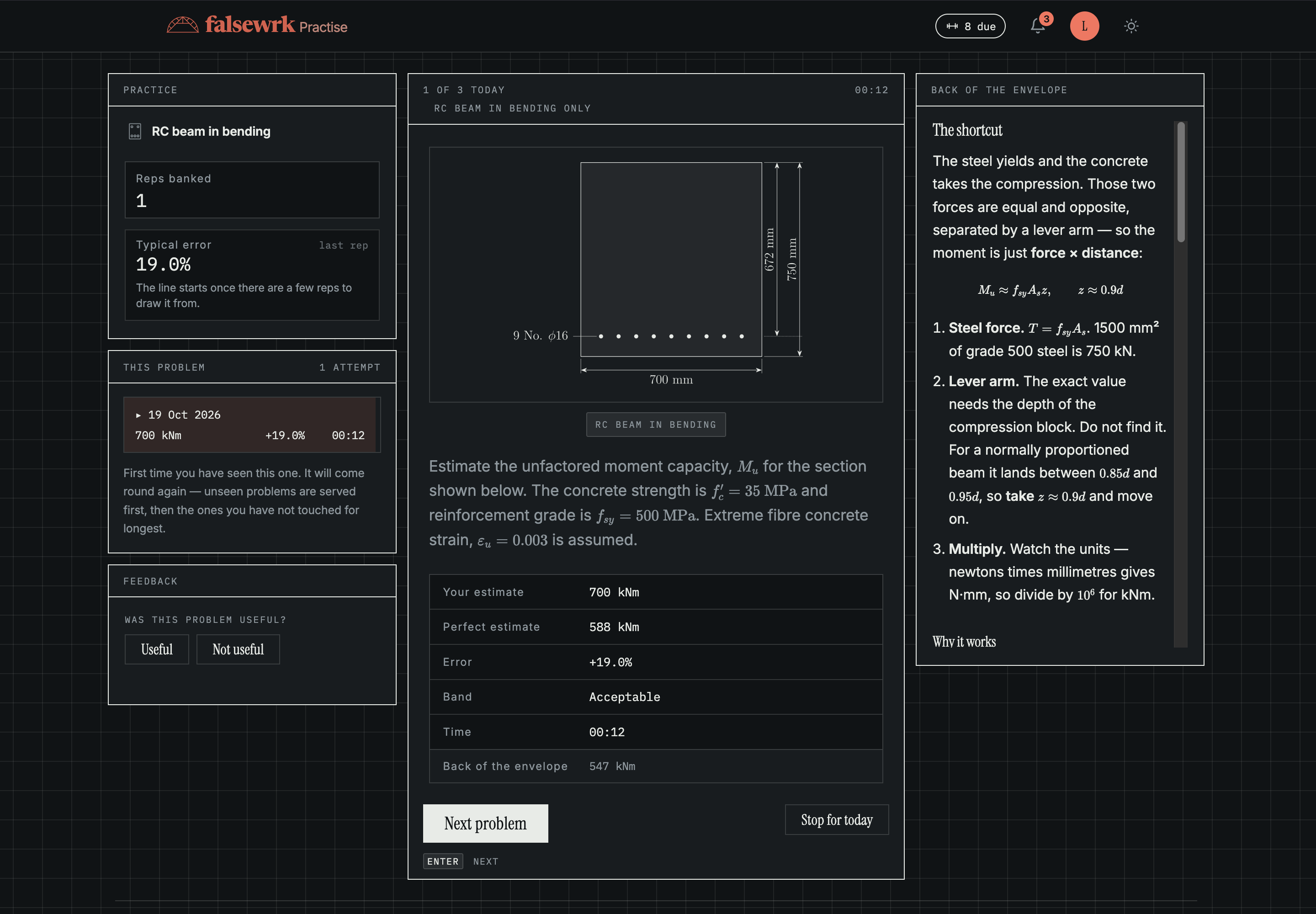
Free while it's being built. Ten minutes tonight and you'll know whether your instinct for a concrete section is any good. Four types today — reinforced concrete sections in metric or imperial, steel sections, one-way slabs, and the deflected shape of a beam or portal frame — and more being added.
Nobody gets enough reps anymore.
Judgement cannot be taught, it's absorbed from the work and the people around you — from seeing enough of it. It has traditionally been a lottery. The right project, the right supervisor and the right few years. Get those and you came out the other side on a fast track to mastery.
Miss them? You’re ten years in with only five years of reps. It’s not your fault you spent two years on condition assessments in a slow market, or three years on a project where nobody has time to explain anything. The hours you would have spent working something out properly went to the program or fee.
You can’t practise a thing you don’t get to do.
So the reps have to come from somewhere else. Not a course you sit through — a drill you can do tonight, and again on Thursday.

I've spent almost 15 years working on infrastructure. Most of that designing bridges. From mega projects like Sydney Gateway to small bridge condition assessments and design reviews. I got lucky. The right projects, the right people, complex structures early enough to learn on. Most engineers don't get that, and I don't think it should come down to luck.
To become an expert in something — heck, even to become proficient at something — you can't just do it once. You need to do it 50 times. How long does it take you to get 50 reps at anything? In engineering, it can take decades — and you don't find out which side of it you're on until you're ten years in. What if we were able to condense that feedback loop into a few years of deliberate practice instead?
This idea has been brewing for a while. Early in my career, I took a detour: leaving engineering to run a martial arts gym full time. I watched students nod along and ask intelligent questions while I demonstrated a technique and explained its relevance. Then I watched them fumble the same technique the first fifty times. It's one thing to intellectually understand something, but you also need to feel your shoulder turn over and protect your chin as you punch. You need the visceral understanding that can only be obtained through doing. Nobody in a gym believes you can explain a skill into somebody.
Capability is not explained into people.
It is drilled in.
With martial arts, the feedback is immediate. You can get good really quickly. But with engineering, the feedback takes decades. This is an attempt to tighten that feedback loop.
I'm building falsewrk the way you build a gym: reps on real anonymised deatails and problems rather than lectures, and somewhere to keep turning up. This is not a cheat sheet. It requires you to put in the work, but supports you by providing the reps, a place to do them and schedules them so you don't need to remember when you should review.
This subject is too important to be only my view of it. To support this, I'm assembling a panel of experienced practitioners across specialisations to help write and stress-test the material.
The way engineers are developed is under threat. I'm building falsewrk so that in ten years' time there are still engineers who can tell when the answer is wrong.
You can already design a beam.
You can size it, reinforce it, check it and issue it — with the spreadsheet open and an hour to spend. But did you know the answer was before you did it?
This is a gym, not a lecture theatre. There are problems you work on until you own them. Think about the problem. Estimate the answer. Be wrong. Look at the answer and think about why. Get a similar problem a few days later when your memory fades and try again.
That's it. With a large enough library of practical engineering problems, we cancels apply this framework to all of them. Now you don't need to wait for the right project.The reps are yours.
The shape of a rep
- 01
Look at a realistic problem you might face, with no software in front of you.
Think about the various constraints on the problem and how these affect the answer. But also trust what your gut says about the problem.
- 02
Commit to a number before you are ready to.
Estimate it in your head or on the back of something. Thirty seconds, not thirty minutes — the point is the instinct, not the arithmetic. This is the part that transfers to a meeting.
- 03
Find out immediately how close you were.
Marked the moment you commit, against the real answer, with the working you can read afterwards. You learn in ten seconds what a project might take ten months to tell you.
- 04
Again in a few days, when you have half forgotten it.
Each type comes back on a spacing schedule, days after you last saw it. A week later you find out whether you learned it or only recognised it.
Four steps. A couple of minutes a rep, and the same problem gets harder to fool you each pass.
Be wrong here.
Not in the meeting.
The engineers everyone brings the hard problem to were not born knowing the answer. They were wrong enough times, early enough, to stop being wrong.
Free while it's being built. No card, no cohort to wait for.